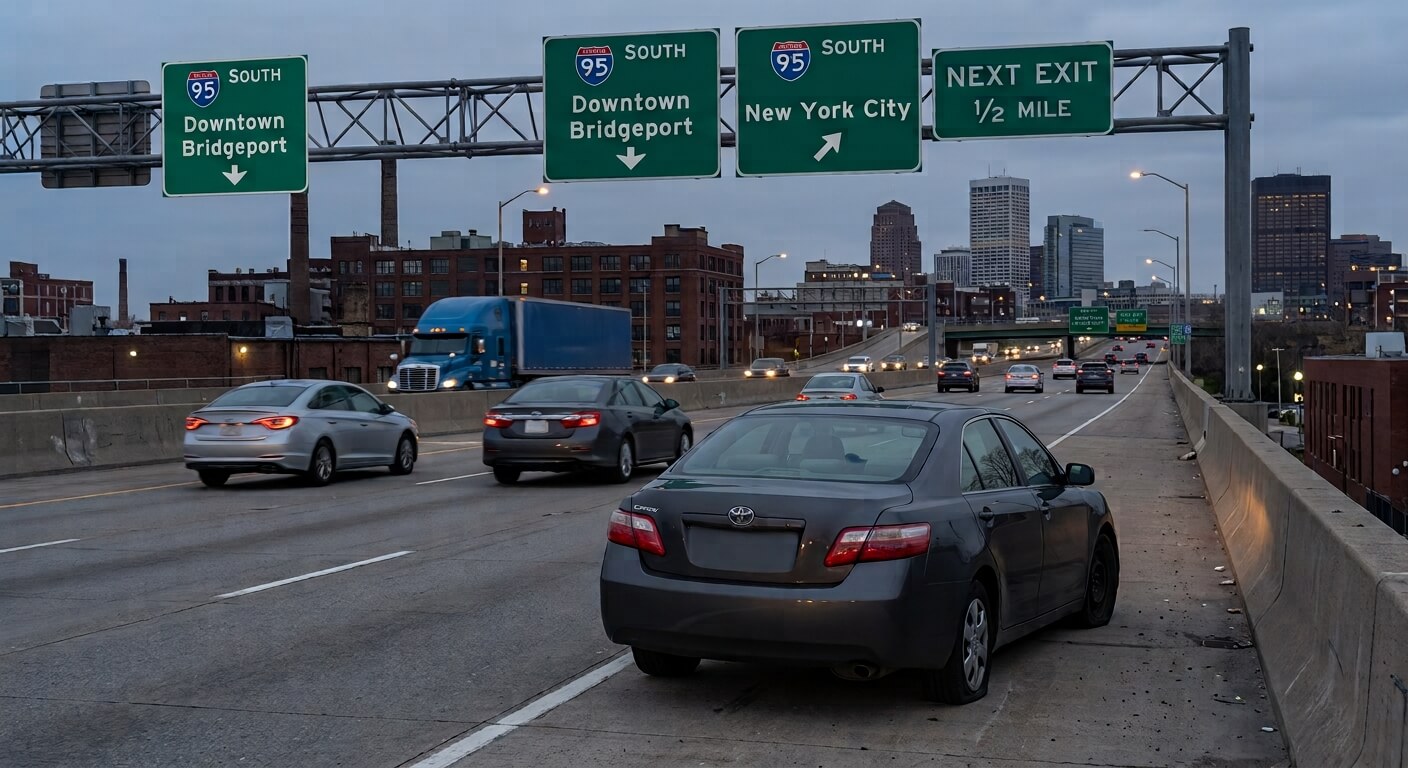
You’re on the highway, a tire goes flat, and the next exit is right there — maybe half a mile away. It feels reasonable to just creep along and get off the highway rather than stop on the shoulder. The honest answer is: you shouldn’t, and the reasoning comes down to what a “flat” tire actually means for how your car is supported.
Why a Flat Tire Changes Everything Immediately
A tire’s air pressure isn’t just there for a smooth ride — it’s what holds the tire’s shape and keeps your vehicle’s weight riding on the tread, not the wheel itself. The moment a tire goes fully flat, that support disappears. The car’s weight shifts onto the wheel rim, which is metal, not designed to touch the road, and has none of the flex or grip that a properly inflated tire provides.
This isn’t a gradual problem that gets slightly worse the longer you drive — damage can start within the first few hundred feet, and a tire that might have been repairable if you’d stopped immediately can become a total loss within a very short distance.
What Actually Happens to the Tire and Rim
- The rim takes the impact. With no air cushioning it, the rim contacts the road directly, which can bend, crack, or gouge it — especially on alloy wheels, which are more brittle than steel.
- The tire’s internal structure breaks down. The sidewall isn’t built to bear weight; doing so causes it to flex, overheat, and tear internally in ways you can’t see from the outside, often destroying the tire even if it looked salvageable when it first went flat.
- Handling gets worse, not better, as you go. A flat tire pulls the vehicle to one side and makes braking and steering less predictable — the longer you drive on it, the more that instability tends to increase, not settle.
But It’s Just Half a Mile” — Why Distance Doesn’t Make It Safe
It’s tempting to think a short distance is a reasonable exception, but the damage isn’t really about how far you go — it’s about the fact that the tire has zero air pressure at all. Even driving a few hundred feet on a completely flat tire can be enough to deform a rim or destroy the tire’s internal structure. Half a mile isn’t a small ask for a tire that’s lost all its support — it’s more than enough distance to turn a fixable flat into a totaled tire and a bent rim.
The One Real Exception
There is a narrow case where creeping forward makes sense: if stopping exactly where you are is genuinely more dangerous than moving — you’re blocking an active lane, sitting on a blind curve, or stopped somewhere with no visibility for approaching traffic. In that specific situation, moving a short distance to reach a safer stopping point is reasonable, even knowing it may cause some damage. What that doesn’t cover is continuing on to an exit, a gas station, or home because it’s more convenient — that’s a choice being made for comfort, not safety, and it’s the scenario that causes the most damage.
What to Do Instead
- Pull over as soon as it’s safe — onto the shoulder, into a parking lot, or anywhere out of the active lane, rather than pushing toward a specific destination.
- Turn on your hazard lights immediately so other drivers see you before they’re close.
- Check if you have a spare and know how to use it. If you’re in a safe location — a wide shoulder or a lot, not a narrow lane with traffic close by — changing the tire yourself may be an option.
- Call for a tow or roadside assistance if you can’t safely change it yourself, especially on a highway shoulder where changing a tire next to live traffic carries its own risk.
If you’re on the elevated stretch of I-95 through downtown Bridgeport, this matters even more — the shoulders along that section tend to be narrower than on a typical highway, so there’s less room to fully clear the travel lanes. Wherever the flat happens along that stretch, get as far onto the shoulder as the road allows and stay inside the vehicle with your seatbelt on rather than trying to reach a wider spot further down the road.
Why a Tow Often Costs Less Than “Just Getting There”
It can feel like calling for a tow over a flat tire is overkill when the exit is so close. But weighed against the cost of a new rim, a destroyed tire, and potentially a suspension or alignment issue from driving on a collapsed tire, a short tow is often the cheaper outcome — not to mention the safer one. A flat tire towed a short distance is a routine, inexpensive call. A bent rim and blown sidewall from trying to save that call often costs more than the tow would have.
Need a Tow for a Flat Tire in Bridgeport?
If you’ve got a flat tire and can’t safely change it yourself, don’t risk the rim or the tire trying to reach the next exit. Elon Heavy Duty Towing provides fast, local towing throughout Bridgeport and Fairfield County — 24 hours a day, 7 days a week.